
Best Picture Review #7: Precious: Based on the Novel "Push" by Sapphire

There are two things that make Precious stand out from all those other cookie cutter movies: the first is the way director Lee Daniels handles Precious' first person account. Daniels slips in between reality and fantasy throughout the narration and exposition of the film, to great effect. Even during the lowest moments of Precious' life (and boy, are they low), she is daydreaming about how it could be better. The dreams are vivid and somehow both far-fetched and realistic. What this allows Daniels to do is inject hope into an utterly hopeless situation without cheapening or watering down the story. I also appreciated the use of the handheld camera in certain situations to emphasize where Precious' focus was (although it tended to be distracting in parts).
The other distinctive feature of Precious is the realistic depiction of the moral ambiguity of the secondary characters. Daniels chooses not to paint the teacher and the social worker and the nurse as merely perfect selfless robots, but as normal people trapped in the system who happen to be performing extraordinary heroic acts on Precious' behalf. This ambiguity, personified especially by the performances of Paula Patton, Mariah Carey (yes, that Mariah Carey), and Lenny Kravitz (yes, that Lenny Kravitz) is what pushes Precious from good to great. 4.5/5
Best Picture Review #6: An Education

Mostly, though, the film does examine the education Jenny receives from David. Their on-screen romance is awkward at best, but I think that's what makes the film work. Jenny was never really in love with David himself, but with the idea of being liberated and whisked away to France while her man-friend does his Eddie Haskell routine with her normally overbearing father.
I really enjoyed the treatment that Scherfig gives to Jenny's character. As she gets more and more wrapped up in her "adult" life, Jenny's surroudings, costumes, hair, demeanor, and disposition transform as well. It is clear that this experience has changed her. Is it for the better? The film almost lets you make that decision for yourself, but the ambiguity is lost in the terrible ending.
An Education is based on a true story. The real Jenny, Lynn Barber, wrote a short memoir about it, which can be found here (major spoilers). The film remains very truthful to Barber's account, but the ending takes her conclusions and goes in a completely different direction. Consider the following statement from Barber (spoiler, highlight to read):
What did I get from Simon? An education - the thing my parents always wanted me to have. I learned a lot in my two years with Simon. I learned about expensive restaurants and luxury hotels and foreign travel, I learned about antiques and Bergman films and classical music. All this was useful when I went to Oxford - I could read a menu, I could recognise a fingerbowl, I could follow an opera, I was not a complete hick. But actually there was a much bigger bonus than that. My experience with Simon entirely cured my craving for sophistication. By the time I got to Oxford, I wanted nothing more than to meet kind, decent, straightforward boys my own age, no matter if they were gauche or virgins. I would marry one eventually and stay married all my life and for that, I suppose, I have Simon to thank.
Why, then, does Jenny narrate that she'll act is if she'd never been to Paris? It seems as if the screenwriters are trying to insert a happy ending into a story that already has one, which to me killed all the emotional momentum the film had going for it. Still, up until that point An Education is a fantastic character study, and for that reason alone I recommend watching it. 4/5
Best Picture Review #5: Inglourious Basterds
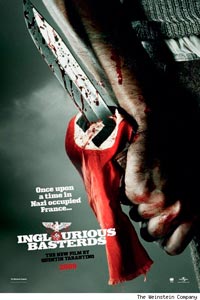
Tarantino's quirky fingerprints are all over IB, from the misspelled title (speculated to be accidental in this humorous post) to the film's complete (and obviously purposeful) lack of historical accuracy. These quirks are very off-putting to many, but as a QT apologist, I see the value in many of the oddball things he does. An example: In the very tense 21-minute opening scene, Colonel Hans Landa (superbly portrayed by Christoph Waltz, my pick for Best Actor) and Perrierr LaPadite are speaking in French (they are in France, after all) when Colonel Landa casually suggests that they switch to English. When watching it the first time, I inwardly groaned, thinking this was one of THOSE movies where the foreign characters speak English only so that American audiences won't complain about having to read subtitles. I should have known that this would end up being an important plot point, and it was. (Of course, it opens up a possible plot hole at the end; if you've seen the movie, think about the inserted scene in the theater.)
Overall, I think Tarantino uses his powers for good here. His over-the-top violent style actually seems quite perfect for the subject matter. Likewise, The double Mexican Standoff scene (another Tarantino trademark), while ridiculous, doesn't seem unnecessary and actually serves to move the plot along quite nicely while adding a layer of intrigue to the proceedings when the separate storylines start to intertwine.
This convergence of the seemingly very different stories is nothing short of masterful. The protagonists of each story never even meet, but they are kindred spirits in many ways. One, Shoshanna, is motivated by personal revenge, while the other, Lt. Aldo Raine, seems to be spurred on by a sense of justice (as well as a desire for scalps). Each faces significant obstacle to achieving their purpose, and while it may seem far-fetched that each has to go through Col. Landa to get there, the confrontations don't feel forced at all. In the end, both the effectiveness and futility of each character's actions are represented by the American Jews that stand on a balcony shooting at people who are dying in a theater fire anyway. In Tarantino's world, the final victory is both inevitable and completely dependent on the resolve of the major players. The resulting tension is profound.
I'm not sure that you could have planned for a greater irony than for this film to be nominated for a Best Picture Oscar. Holocaust and other World War II flicks are invariably highly favored by the Academy, and Inglourious Basterds is as close to a parody of the genre as you can get while remaining respectful. Even so, it never feels like a parody. It is indeed a masterpiece. 5/5
Best Picture Review #4: Up

If you think about it, every single one of the Pixar films has at least one memorable scene that advances the plot without using a single spoken word, and I think that's what makes their films distinctive. In Up, they have perfected the art. Consider the following scene (it's from the first act, so there's no spoilers here):
That's not even the only important scene to utilize this technique. The adult Ellie has no lines, yet she's an important character all the way to the end.
There's plenty to be said about the words that are spoken as well. The characters that you don't expect to talk are maybe the funniest, and they provide comic relief at all the right times. This device in lesser hands would have been a serious detriment to the overall feel of the movie, but directors Pete Docter and Bob Peterson made sure that the silly elements didn't dominate.
Ultimately, Up is about how one man deals with grief, and while I'm typically skeptical of movies where everything is wrapped up neatly at the end, the storytelling here is so masterful that I don't think viewers should feel cheated. In fact, the inclusion of the stowaway and the relationship he develops with Carl makes it that much more believable, not to mention more relatable. Up is the first animated movie since Beauty and the Beast to be nominated for Best Picture, and the distinction is more than deserved. I can't think of another animated movie that's tried to do so much and succeeded. 5/5
Best Picture Review #3: District 9

As the mockumentary structure advances the storyline, it becomes increasingly apparent that the audience is being set up for a huge bait-and-switch (minor spoilers ahead). Wikus van der Merwe's eventual victimization is fairly predictable, but the manner in which his rejection comes to be was a pleasant surprise to me. His somewhat Kafka-esque metamorphosis provides some of the more poignant and thought-provoking scenes of the film. The scene where Wikus' wife Tania calls him back - apparently after much deliberation; Blomkamp takes care to tell us plenty of time has passed - and accepts him despite his compromised state was a particularly touching scene.
However, the problem with that precise scene underscores the problem of the film of the whole - the story runs out of steam and starts to rely on action movie cliches. When watching the scene in question the first time, I was hung up on the idea that the phone call might be a trap set by fictional MNU to get a fix on the cell phone location. (Sorry to be so vague. If you've seen the movie, you understand that I'm trying to avoid spoiling too much.) In fact, MNU has not thought of this and is apparently resigned to spreading negative propaganda. The subsequent scenes resemble a capture the flag game that could have been in the Halo movie that Blomkamp and producer Peter Jackson were reportedly working on before moving on to District 9.
While the final act seems weak due to way too many last-second close calls, it could have been redeemed had the relationship between van der Merwe and Christopher Johnson been stronger. D9 tries to sell Wikus' final act as selfless and sacrificial, but given his repeated pleas to Johnson to "fix him," his transformation as a character rings false.
In light of this disappointing denouement, the promise of a cutting commentary on humanity that District 9 makes at the outset seems hollow. The effect is almost as if the two halves of the movie were written by two different people, which is entirely possible given the split screenwriting credit. I wrote this review once before deleting it and writing a more favorable review (it may not sound like it, but there's plenty to like here), but eventually I came back and rewrote the original one. I don't think it's overly harsh to be down on the movie as a whole because it doesn't live up to its own lofty expectations, especially when they're made so explicit as I outlined above. I look forward to a more experienced director remaking this movie in 20 years. A successful formula for the fictional future director living in my head would be to keep the first two-thirds of the story and then to take the ending in a completely different direction. Here's hoping. 3.5/5
Best Picture Review #2: Up in the Air
This review contains minor spoilers. You've been warned.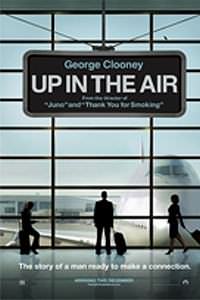
Up in the Air is without a doubt a romantic comedy on the surface. Go snorkeling a little bit, though, and you'll find that there's so much more.
At its very core, UitA has a philosophical question for you - is having and cultivating relationships worth the trouble, or is having that much weight on your shoulders holding you back - personally or professionally? It's not a unique question for Hollywood - the content itself doesn't differentiate itself from, say, The Family Man starring Nicolas Cage, but the execution in answering that question sets it apart.
How so? For me, the scene that forces the issue is the one in Detroit. They're testing they're new technological way of firing people, which results in an odd set-up where Ryan (George Clooney) and Natalie (Anna Kendrick) are firing people from the next room. Ryan, a man who believes in keeping people at a distance, has been resisting the changes because he knows that helping someone "transition" requires a personal touch, but he hasn't noticed the tension until now. In the moment where a just-fired distraught employee walks past their conference room, Ryan gets it. I love it when the moment of realization in a character study is palpable like this. The director, Jason Reitman, also did Juno and Thank You for Smoking, and this is exactly what makes those movies great as well. In each of these three movies, you can see the main characters cognitively recognize how they're supposed to change, and here's the rub: they never do it right away. Isn't it like that in real life? It takes some time to change your actions even after you've changed your belief system.
Of course, what this does is set up a cheesy moment like the one I mentioned at the beginning, with the running through the airport and all. If you haven't seen the movie and you've read this far, I've already ruined it for you anyway, so I don't mind telling you that this actually happens. This is the struggle that I have with UitA: it was an amazing character study. All three characters did brilliantly. For the most part, the narrative structure was tight and purposeful. But it seemed like Reitman didn't know how to end it. The twist at the end was believable, but lazy. MAJOR SPOILER (highlight to read): Sure, the fact that Alex had a real family allowed her to say that line about Ryan being her escape from real life, but then why did she agree to go to the wedding? A better plot line would have been for her to have several other "escapes" that she encountered on the road. And let's not forget the gigantic elephant in the room: product placement. Call me a purist, but that was way too much. Overall, I really liked Up in the Air, but it suffered from some fatal flaws that make me wonder why it was nominated for Best Picture. 4/5
Best Picture Review #1: Avatar
I will be reviewing all of the Best Picture nominees in the days leading up to the Academy Awards on Sunday, March 7, just as I did last year. (You can find those reviews by clicking "Academy Awards" under "Labels" to the right.)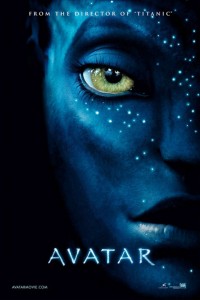
First, let's talk about special effects, which almost seems like a misnomer. Effects implies that something was added in post-production, and nothing could be further from the truth here. According the The New Yorker (link NSFW - language), Avatar is "the first big-budget action blockbuster [shot] in 3-D." James Cameron wrote the script in 1994, but the technology wasn't good enough to actually shoot the idea. It wasn't until he saw Gollum on screen in one of the LOTR movies that he was convinced that the technology was ready, and even then he basically had to invent his own camera to accomplish what he did.
The result is absolutely breathtaking. Cameron is quoted as saying (back in early 2007!), "Ideally at the end of the day the audience has no idea which they're looking at," and in my opinion, he accomplished just that. There were only a couple of instances in the entire 162 minutes that didn't ring true to me, but those were very easily overlooked. (An example would be at about 2:56 of this video, where one Avatar pushes another and it just doesn't look quite right - understand that I'm really nitpicking here.) Have I said enough about the technical achievement yet? If you haven't seen it, go watch it in 3-D at the theater while you still can. This will probably be the first movie that's done an injustice by putting it on Blu-ray.
The vast majority of the criticisms I've heard about Avatar concern the story. Let me summarize them for you: it's not completely original. A simple internet search led me to comparisons of Dances with Wolves, Delgo, Dune, FernGully, The Last Samurai, Pocahontas, and many, many others. While it is true that Avatar and several of these movies share common archetypes, I don't think that this really diminishes the story arc at all. Cameron's screenplay challenges militarism and ethnocentricism (among many other topics), and since we apparently aren't getting the message, I'm okay with stories that attempt to engage these topics in a fresh way. If anything, the message is a little heavy-handed. Note to Mr. Cameron: Using the phrase "shock and awe" is the opposite of subtlety.
My quibbles with Avatar concern more of the same problems that affect other Hollywood blockbusters: too many shallow characters (especially Col. Quaritch and Trudy), cheesy one-liners, monologues given by the bad guys before they die, and plot twists that exist solely to justify more explosions. In a regular action flick, it's easy to overlook these flaws, but not in this case, at least not for me. Avatar aspires to be included among the Pantheon of Great Movies, and while I certainly agree that it will go down in history as a hugely influential work, it falls short of being an all-time great. 4.5/5.