
Best Picture Review #2: Up in the Air
This review contains minor spoilers. You've been warned.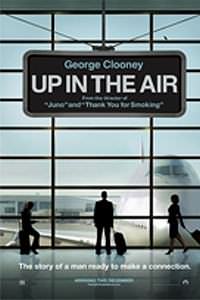
Up in the Air is without a doubt a romantic comedy on the surface. Go snorkeling a little bit, though, and you'll find that there's so much more.
At its very core, UitA has a philosophical question for you - is having and cultivating relationships worth the trouble, or is having that much weight on your shoulders holding you back - personally or professionally? It's not a unique question for Hollywood - the content itself doesn't differentiate itself from, say, The Family Man starring Nicolas Cage, but the execution in answering that question sets it apart.
How so? For me, the scene that forces the issue is the one in Detroit. They're testing they're new technological way of firing people, which results in an odd set-up where Ryan (George Clooney) and Natalie (Anna Kendrick) are firing people from the next room. Ryan, a man who believes in keeping people at a distance, has been resisting the changes because he knows that helping someone "transition" requires a personal touch, but he hasn't noticed the tension until now. In the moment where a just-fired distraught employee walks past their conference room, Ryan gets it. I love it when the moment of realization in a character study is palpable like this. The director, Jason Reitman, also did Juno and Thank You for Smoking, and this is exactly what makes those movies great as well. In each of these three movies, you can see the main characters cognitively recognize how they're supposed to change, and here's the rub: they never do it right away. Isn't it like that in real life? It takes some time to change your actions even after you've changed your belief system.
Of course, what this does is set up a cheesy moment like the one I mentioned at the beginning, with the running through the airport and all. If you haven't seen the movie and you've read this far, I've already ruined it for you anyway, so I don't mind telling you that this actually happens. This is the struggle that I have with UitA: it was an amazing character study. All three characters did brilliantly. For the most part, the narrative structure was tight and purposeful. But it seemed like Reitman didn't know how to end it. The twist at the end was believable, but lazy. MAJOR SPOILER (highlight to read): Sure, the fact that Alex had a real family allowed her to say that line about Ryan being her escape from real life, but then why did she agree to go to the wedding? A better plot line would have been for her to have several other "escapes" that she encountered on the road. And let's not forget the gigantic elephant in the room: product placement. Call me a purist, but that was way too much. Overall, I really liked Up in the Air, but it suffered from some fatal flaws that make me wonder why it was nominated for Best Picture. 4/5
Best Picture Review #1: Avatar
I will be reviewing all of the Best Picture nominees in the days leading up to the Academy Awards on Sunday, March 7, just as I did last year. (You can find those reviews by clicking "Academy Awards" under "Labels" to the right.)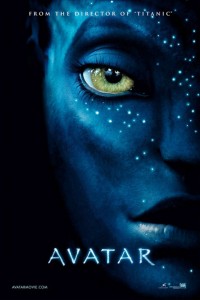
First, let's talk about special effects, which almost seems like a misnomer. Effects implies that something was added in post-production, and nothing could be further from the truth here. According the The New Yorker (link NSFW - language), Avatar is "the first big-budget action blockbuster [shot] in 3-D." James Cameron wrote the script in 1994, but the technology wasn't good enough to actually shoot the idea. It wasn't until he saw Gollum on screen in one of the LOTR movies that he was convinced that the technology was ready, and even then he basically had to invent his own camera to accomplish what he did.
The result is absolutely breathtaking. Cameron is quoted as saying (back in early 2007!), "Ideally at the end of the day the audience has no idea which they're looking at," and in my opinion, he accomplished just that. There were only a couple of instances in the entire 162 minutes that didn't ring true to me, but those were very easily overlooked. (An example would be at about 2:56 of this video, where one Avatar pushes another and it just doesn't look quite right - understand that I'm really nitpicking here.) Have I said enough about the technical achievement yet? If you haven't seen it, go watch it in 3-D at the theater while you still can. This will probably be the first movie that's done an injustice by putting it on Blu-ray.
The vast majority of the criticisms I've heard about Avatar concern the story. Let me summarize them for you: it's not completely original. A simple internet search led me to comparisons of Dances with Wolves, Delgo, Dune, FernGully, The Last Samurai, Pocahontas, and many, many others. While it is true that Avatar and several of these movies share common archetypes, I don't think that this really diminishes the story arc at all. Cameron's screenplay challenges militarism and ethnocentricism (among many other topics), and since we apparently aren't getting the message, I'm okay with stories that attempt to engage these topics in a fresh way. If anything, the message is a little heavy-handed. Note to Mr. Cameron: Using the phrase "shock and awe" is the opposite of subtlety.
My quibbles with Avatar concern more of the same problems that affect other Hollywood blockbusters: too many shallow characters (especially Col. Quaritch and Trudy), cheesy one-liners, monologues given by the bad guys before they die, and plot twists that exist solely to justify more explosions. In a regular action flick, it's easy to overlook these flaws, but not in this case, at least not for me. Avatar aspires to be included among the Pantheon of Great Movies, and while I certainly agree that it will go down in history as a hugely influential work, it falls short of being an all-time great. 4.5/5.
The Book of Eli

Warning! This post contains major spoilers for "The Book of Eli." I strongly recommend that you see the movie before reading this.
The Book of Eli is, for lack of a better term, prophetic. I hedge my bets a little because this interview leads me to believe that perhaps I'm drawing more meaning from the movie than perhaps the filmmakers are themselves. Still, I believe that God can speak through people despite their intentions. Even if you can't go there with me, I think you'll agree that there are "lessons" to be found in the ordinary.
Depending on your viewpoint, the message of TBoE is either really good or really terrible news. This wasn't evident to me immediately, but upon further reflection I have come to this conclusion. I believe this is true for other works in the same genre. Perhaps the most famous entry in the Apocalyptic tradition, Revelation, contains an extensive passage that explicitly backs up this claim. In Chapter 18, Babylon, the symbol of excess wealth (among many other things) falls, and the people who have built their lives on the sandy ground of materialism weep for it. In the very next chapter, the multitude who have been calling for its destruction celebrate the one who destroyed it. Two groups of people witnessed the crumbling of an empire and had completely different reactions to it.
So it is in TBoE. When asked about the difference between the world they live in versus the one before "The Flash," the titular character observes: "People had more than they needed...we threw away things people kill each other for now." This is the thought of a man who is not invested in the culture of STUFF. In fact, this is the thought of a man who is truly on a mission from God. Contrast his attitude with that of Carnegie. The entire infrastructure of the world has collapsed. Roads and bridges are no more, cannibalism and "hijacking" is commonplace, and even the currency system has been replaced by bartering. Yet Carnegie is a man who is so in love with capitalizing on capitalism that he hoards what is probably the most precious resource in the world (water) and uses his coercive power to gain more power. He exploits the weaknesses of others. Optimistically, we would call him an opportunist. Either way, you have to admit that he is smart. And because he is smart, he knows that one surefire way to control people is through religion.
We Christians don't like to admit that this is true. We're not under anybody's control but our own, we say. (Church of Christ-ers have a particular independent spirit due, in no small part, to the autonomy of our congregations.) But if we're honest with ourselves, how often do we use religion as a means of control over others, both within and without the Church?
There's so much more I want to talk about in regards to this movie - the symbolism of the blind man being the one that "sees" the best and the weak shaming the strong, the fact that Eli's ultimate destination is nicknamed "The Rock," the moral ambiguity of Eli ignoring the women getting raped so he can complete his mission, the subtle and not-so-subtle references the director makes to other post-apocalyptic and dystopic works, and so on. This post was originally a lot longer and rambled more, if that's possible. But ultimately, I cut it down because I want to discuss this question with you. Whose side are we on? When our infrastructure crumbles, are we going to be rejoicing because we have been faithful to the Word of God, or are we going to be devastated because we've used the Word of God as a false pretense to wield power over others?
The 2006 Rose Bowl, Part 2 - Alabama Gets Overhyped
National Championship Game. Texas is in it. So is another undefeated school, a media darling. Texas' quarterback has already had a career that few could dream of, yet he was snubbed for the Heisman again this year. This time, the winner is the running back for the team they're about to play in the title game. The teams have no common opponents, yet most of the populace and even more of the pundits are going with the traditional power. After all, the Big 12 is weak, and Texas struggled against Texas A&M of all teams, only beating them by 10 or 11 points. Don't forget that they can't run the ball.
Listen, I know it's not the 2005 Longhorns that are going to take the field tonight against Alabama, but it sure has that feel. I remember the hype surrounding the Trojans before the game was even played. Mark May, Kirk Herbstreit, and Colin Cowherd were just some ESPN employees who were crowning USC as one of the best college football teams of all time. It turns out that they weren't even the best team that year. This time around, it's not so much Alabama getting the love as it is the SEC. For the past few years, we've heard so much about how great the SEC is that people simply state as fact that they're the best conference, hands down. I don't buy it, and I really don't see how it's relevant. The Big 12 is not playing the SEC tonight. Texas is playing Alabama.
Another reason you can't just assume tonight's game will be a walkover for the Tide: you cannot use the transitive property in sports. People try to do it in college football more than any other sport because when two teams from different conferences get together, there's almost no common opponents. This doesn't happen in real leagues where the league sets the schedule. The problem is, comparing Alabama's win over Florida to Texas' win over Nebraska, for example, is insane. Just the same way, you can't go back in the season and compare Texas' 34-24 win over Texas Tech to Alabama's 34-24 win over Virginia Tech. The reason is that there are way too many variables to consider. People like to use the phrase "comparing apples to oranges" a lot, but I think that analogy was originally used about college football teams. If it wasn't, it should have been.
Finally, the coaching. Alabama folks will tell you that Nick Saban is a great football coach. They may be right. He does a great job of getting his boys ready to play from week to week. The problem is, the National Championship Game is played over a month after the last bit of action. Saban has won a title before, so he can't be terrible at this, but it's not like he's great at it either. In 10 bowl games, his record is 4-6 overall and 1-1 at Alabama, including that embarassment last year against Utah. Mack Brown is 11-5 overall and 8-3 while at Texas. The point is, Mack can coach 'em up when he has a month to prepare for a team, while Saban's ability to do so is questionable at best. Let's not forget that the players in this game are kids. That's the number one thing people overlook when talking about college football, in my opinion. Professionals don't care what the media says; they just line up and play. College kids are affected. When a team is discounted, they tend to play inspired, while teams that have already been crowned tend to play with a sense of entitlement. (By the way, I think that's what happened in the Big 12 Championship Game. Another circumstantial part of the game that people fail to consider when comparing apples and oranges) In 2006, Mack Brown said the following in his press conference the day of the game: "I would like to thank all of the members of the media. I don’t even have to make a pep talk.” He could probably say the same thing today, and I think that's reason enough for Alabama to be scared.
ATTN: Bono Haters
Lots of people love to hate Bono, the lead singer of U2. A lot of it has to do with his perceived vapid self-importance.
I disagree with this viewpoint. I've been paying attention to Bono's guest columns with the New York Times, and they have been intelligent, articulate, and relevant. Here's a list of his Top 10 something or others of the next decade. (I didn't say he could stay on topic.)
There's not a comment page on the NYT website (probably a good thing), so I'm interested to hear your thoughts.
The Best Comedy Movie of the 2000's is...
Dodgeball: A True Underdog Story
Dodge, Duck, Dip, Dive, and...Dodge.
Thanks to all who voted.
The final list, from 1-64 (ties broken using a combination of voting results and original seeding):
1. Dodgeball: A True Underdog Story
2. Anchorman: The Legend of Ron Burgundy
3. Zoolander
4. Hot Fuzz
5. The Hangover
6. Forgetting Sarah Marshall
7. Elf
8. The Simpsons Movie
9. Shaun of the Dead
10. The School of Rock
11. Wedding Crashers
12. Napoleon Dynamite
13. Talladega Nights: The Ballad of Ricky Bobby
14. Meet the Parents
15. Knocked Up
16. Kung Fu Panda
17. Stranger Than Fiction
18. Shrek
19. Super Troopers
20. Old School
21. The 40 Year Old Virgin
22. Hitch
23. Thank You for Smoking
24. 50 First Dates
25. Bruce Almighty
26. Little Miss Sunshine
27. The Royal Tenenbaums
28. Juno
29. The Replacements
30. Starsky & Hutch
31. The Emperor's New Groove
32. Shanghai Noon
33. Step Brothers
34. Get Smart
35. Tropic Thunder
36. Role Models
37. Monsters, Inc.
38. Accepted
39. I Love You, Man
40. Anger Management
41. The Life Aquatic with Steve Zissou
42. Superbad
43. Click
44. Borat: Cultural Learnings of America for Make Benefit Glorious Nation of Kazakhstan
45. Dan in Real Life
46. The Longest Yard
47. Ratatouille
48. Walk Hard: The Dewey Cox Story
49. Blades of Glory
50. Meet the Fockers
51. Be Cool
52. You, Me, and Dupree
53. Mr. and Mrs. Smith
54. Fun with Dick and Jane
55. Analyze That
56. Sideways
57. My Big Fat Greek Wedding
58. Finding Nemo
59. Pineapple Express
60. The Benchwarmers
61. Jackass Number Two
62. Orange County
63. Clerks II
64. Shanghai Knights
The Entire Bracket
Round 1
Round 2
Sweet 16
Elite 8
Final 4
Championship Round
The Comedy Movie of the Decade Final (Finally)
It comes down to this: two hyphenated titles that were released three weeks apart in 2004. Your finalists:
Dodgeball: A True Underdog Story
Anchorman: The Legend of Ron Burgundy
The Entire Bracket
Round 1
Round 2
Sweet 16
Elite 8
Final 4